
PocketList
The inside story of a renter-powered rental marketplace that out-inventoried Craigslist in Los Angeles in under a year, and what building, leading, and shutting it down taught me.
Roles: Co-founder, CEO
Era: 2018–2021
Shared Contributions: Leadership, Culture, Fundraising
Individual Contributions: Product design, Product strategy, User research, Operations
One of our early users, Stephanie, moved from San Francisco to Los Angeles with her husband and their newborn. Work kept her husband in SF, so she ran the apartment search alone. She found a cute two-bedroom in Santa Monica: expensive, but in a walkable neighborhood, the whole deal. They moved their lives down, and set up the nursery first.
Their baby had been a perfect sleeper in San Francisco. The first night in the new place, the baby kept waking up. Same thing the second night. On the third night, frazzled and sleep-wrecked, Stephanie slept in the nursery herself — and only then figured it out. The baby’s room sat directly above the automatic garage door for the entire building’s parking lot. All night, at random intervals, as neighbors came and went, the room shook and roared.
They couldn’t break the lease. They swapped bedrooms with the baby, bought a white noise machine, and lived with it for eleven months.
Here’s what gets me about that story: every fact a listing could have told her checked out. Square footage, price, neighborhood, all as advertised. The thing that wrecked a year of her family’s sleep doesn’t appear on any listing site, because it isn’t listing data. It’s what I came to call experiential data: what a place is actually like to live in, known only to the people who have lived there.
PocketList was our bet that experiential data could fix renting.
What PocketList was
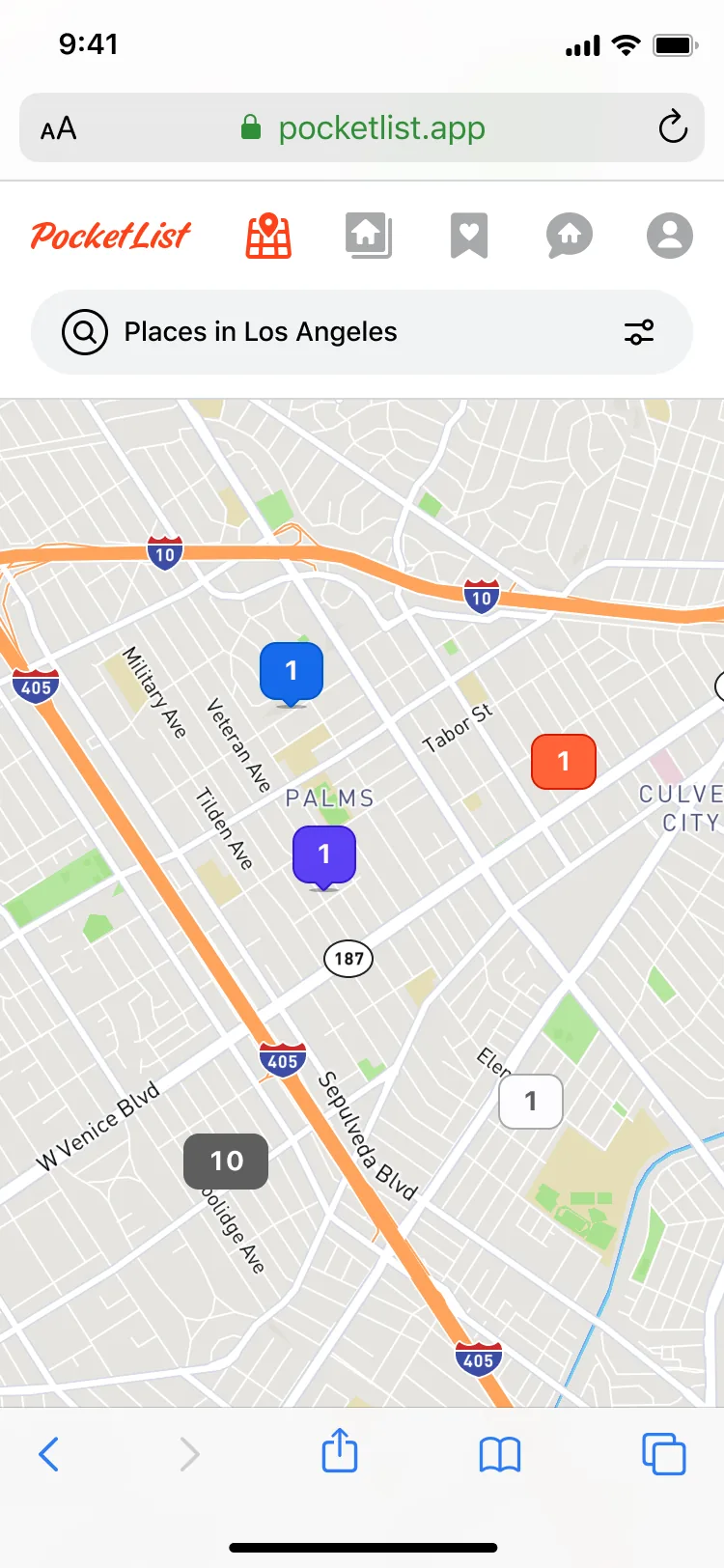
PocketList let renters share their current home before it hit the market, and gave them early access to everyone else’s in return. I co-founded it in 2018 with Julian Vergel de Dios and ran it as CEO until we shut it down in 2021. The average unit on PocketList surfaced 67 days before the landlord got notice and 97 days before it appeared on any listing site. In under a year, we grew to over 50,000 units of inventory in Los Angeles, more than Craigslist had in the city.
It started as a Google Sheet
Before PocketList there was Block, our first swing at the problem: a well-designed, well-built tool for groups of renters to organize an apartment hunt together. It had a viral loop (invite your roommates) and no business model. Growing it was like pulling teeth. When our friends-and-family money ran out, we refused to quit. We took consulting gigs to pay our own bills and kept experimenting on the side.
We launched and killed concepts fast. A Reddit-style board for upvoting the best apartments in a neighborhood. A “chatbot,” years before LLMs, that was actually a phone number with me on the other end, answering rental questions by hand. And then the experiment that worked, which began as a Google Sheet and a few hundred phone calls: “Are you OK with us asking some questions about the place you live in? We promise we’ll never disclose your exact address. But we want to know when you plan on leaving.”
Then we matched people by hand. “Hey Rachel, someone’s looking in your area for a place about your size. You said you’re giving notice in August. Can we get cc’ed on the notice email to your landlord?” We made the introductions ourselves. It took off almost immediately — fast enough that the spreadsheet became a company.
Designing for trust
The whole model depended on people sharing intimate information about their homes: address, rent, photos of the rooms they lived in. The incentive was give-to-get. Share your place, unlock everyone else’s. But incentives only work if people feel safe, and safety is a designed feeling.
The core mechanic: we knew a unit was at 123 Main Street, Unit 2, but searchers only ever saw a quarter-mile radius. Even when our matching knew a unit was perfect for you, the exact address, unit number, and price stayed hidden until the current tenant had moved out. The reveal wasn’t gated on a payment. It was gated on the real-world departure of the person who trusted us with their home.
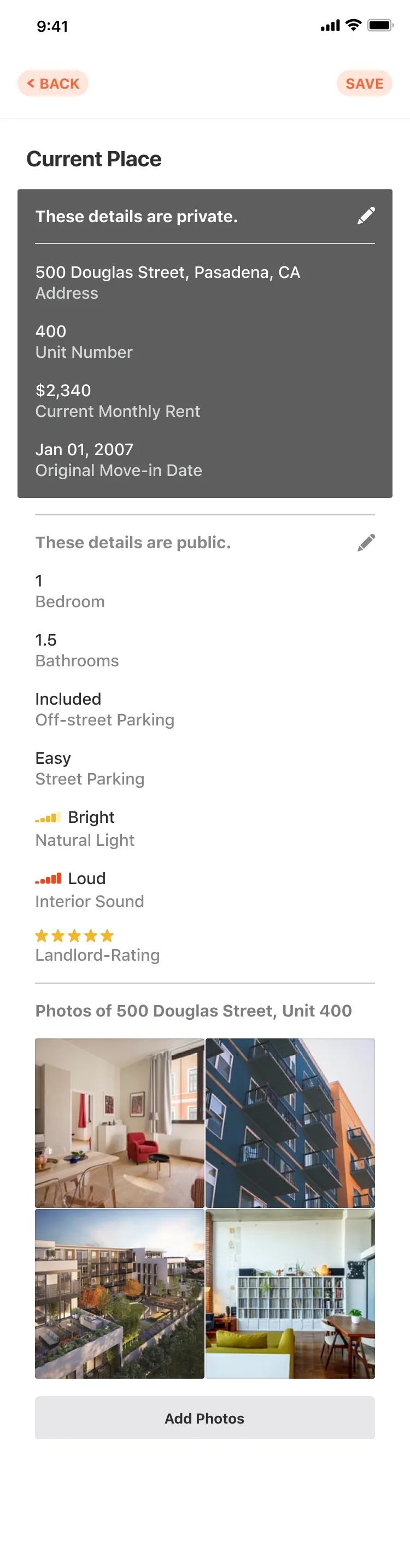
That private/public split was drawn directly in the interface; the screen above is from our actual Figma files. We iterated on the sharing onboarding roughly twenty times in twenty weeks, and consumer software is unforgiving: renters were far pickier about UX than any B2B customer we ever served. I was the only designer on the team, so every one of those iterations was mine (more on what that cost later).
Measuring what listings leave out
Stephanie’s garage door became a design brief: how do you capture what a place is like? Some of it you can ask people. The rest, we measured. With permission, we used the phone’s accelerometer and GPS to work out which direction a unit faced. We used the microphone to take ambient noise readings at different times of day. In buildings where several residents used PocketList (and there were a surprising number) we could model light and sound through the building by floor and facing.
Look at that screen again: “Bright: natural light. Loud: interior sound.” We built the instrument that would have caught Stephanie’s garage door.
A live, interactive re-creation of the Q&A board runs here on the site. It needs JavaScript.
We also started building RenterScore, our attempt at a more equitable, transparent alternative to a credit score: payment history, yes, but also ratings from past landlords and roommates, and contributions to the community. We never got to finish it.
The raise
While Block was starving, I consulted at a startup called Clutter and became close with its CEO, Ari, a founder himself. He tried to hire me full-time more than once; I kept telling him my heart was in my own thing. When PocketList took off, I’d saved enough to quit. When I did, Ari asked, “Did you figure it out?”
I said I thought we had. He asked for a demo, right then. We walked into a conference room and I showed him the sharing onboarding, the flow we’d rebuilt twenty times. When it ended he said, “I want to invest.” I told him we weren’t raising. He said, “Yes you are. As a founder, you’re always fundraising.”
Ari wrote the first check and introduced us up the chain, and most of the round came together over Labor Day weekend, 2019. Our $2.8M seed was led by David Sacks at Craft Ventures, with Abstract VC, Wonder Ventures, and Zillow co-founder Spencer Rascoff: the founder of the incumbent, backing the thing built to leapfrog it. What closed that lead check wasn’t a deck. We never opened one. It was a working product demo, an onboarding flow designed until it could carry the whole argument by itself.
Then the market inverted
COVID arrived weeks after the round closed. We’d signed a commercial office lease and moved in on March 1, 2020; we spent exactly seven business days in that office before lockdown, and lost real money breaking the lease. Not existential, but a permanent lesson about staying lean before you’re default-alive.
We launched publicly into the pandemic anyway, in July 2020, on a contrarian hypothesis: people still needed to move, but nobody wanted strangers walking through their home, so PocketList’s remote-first, data-rich listings might become a growth engine. For a while, it looked like we were right.
What we couldn’t out-design was our own business model. Revenue came from landlords, who paid us because we could demonstrably cut their vacancy time. When eviction moratoriums passed, especially in Los Angeles, landlords started canceling: “I can’t justify paying for marketing software when I don’t know when my next unit is going to be able to turn.” They weren’t wrong. By early 2021 the picture was clear, and a bridge round didn’t come together. We decided to shut down, and returned what money remained to our investors.
The LA eviction moratorium wasn’t fully lifted until years later. No runway we could have raised would have been long enough. Strangely, that’s the comfort: we didn’t die of a bad product or a bad team. We died of a once-a-century event landing squarely on our revenue model. It doesn’t stop me from being sad about it. I think we had the makings of a Cinderella story.
“I’ve got your back”
The team was mostly made up of engineers, many of them found and mentored by Julian, some very young. We shipped constantly, kept egos low, and trusted each other completely. At the end of every sprint planning and every retro, we said the same thing out loud: “I’ve got your back.” It sounds small. Practiced for years, it builds a support structure under everything else. If everyone is trying to make everyone else look good, most of the usual startup pathologies never take root.
The shutdown announcement brought tears and some disbelief. Helping the team through that grief was part of my job as a leader, and I was proud to do it. I placed every single member of the team in a new job before I went looking for my own. People from that team still tell me it was the best job they’ve ever had. Of everything in this story, that’s the outcome I protect most carefully.
What it left me with
Some of what PocketList taught me is tactical:
- stay lean until you’re default-alive
- users are a harder examiner than any investor
- growth beats a working product
- a working product beats a deck
One lesson was personal enough to change how I build companies. I did all of the design and all of the product work myself, as CEO: “Nick shoveling coal into an engine of eight engineers.” I was proud of the output, and it cost me focus and health. At my next company, one of my first hires was a designer I trusted deeply, and who was more talented than I am.
And one thread only became visible later. Back in the Block days, our best-loved feature was Scouts: dispatch a person to visit an apartment for you, photograph it, rate it. Our first true-believer user, Lauren, ran her own company, and what she actually valued was simpler than real estate. It was having help. An assistant for one of life’s second jobs. I didn’t recognize it then, but I’ve been building toward that same idea ever since. It’s what Familiar is.
Julian and I shut PocketList down and came out closer than we went in. We’ve built together since, and we’re building together now. The company didn’t survive. Everything important about it did.