Heirloom
The inside story of Heirloom: a bet that the digital deserved object permanence, a 2.7-second login, a deal that died at the lawyers' table, and what still exists on-chain.
Roles: Co-founder, CEO
Era: 2021–2024
Shared Contributions: Leadership, Culture, Fundraising, Product design, Brand design, Business development, Sales
Individual Contributions: Product strategy, Operations
An industrial designer gets something we never did. Pour a year into a chair and the chair simply continues to exist: no server bill, no maintenance window, no dependency to patch. Julian and I had been building digital products together for a decade, and everything we’d ever shipped was one unpaid invoice away from vanishing.
In 2021, that stopped being abstract. As we shut down PocketList, users wrote asking to keep proof of their own history with us. Once the servers went dark, we had nothing to give them. Years of work, thousands of relationships, more rental inventory than Craigslist: erased, the way software is always quietly being erased.
Julian had been chewing on the answer for years. After our first startup jobs together, he’d been the first employee at Gem, a Bitcoin wallet company in Venice Beach, and had come away worn down by crypto’s financialization but convinced the underlying technology mattered for a different reason: for the first time, bits could be made permanent. Mint an identifier on a public ledger and it exists the way the chair exists. The W3C had a spec for this (decentralized identifiers) and a companion standard called verifiable credentials: claims about a person, cryptographically signed, with a public ledger as the source of truth instead of somebody’s AWS instance.
Heirloom was our bet that bits deserved object permanence.
What Heirloom was
Heirloom made no-code tools for institutions to issue and verify credentials: degrees, transcripts, memberships, employment records. I co-founded it with Julian in 2021, as CEO to his CTO, and we closed our seed round on Christmas Eve, 2021, raising $8M co-led by Ripple and Forte.
The first lesson from PocketList got applied before almost anything else: one of our first hires was Stephen Calvillo, a designer I’d worked with at Fullscreen, who’d gone on to LinkedIn and Lyft (and after Heirloom, Stripe). Handing the craft to someone more talented than me was a tremendous relief. We strengthened each other’s thinking, and it accelerated everything from the product experience to the brand. My own weeks filled with what PocketList never got enough of from me: business development and sales.
Three seconds
QuickLogin, our authentication product, started with an observation about airport gates. A boarding pass QR code feels like a ticket, but it’s really a package of information about you: your name, a frequent flyer number, sometimes a passport number. When the gate agent scans it, you’re transmitting personal data, with a kind of consent you never quite registered giving.
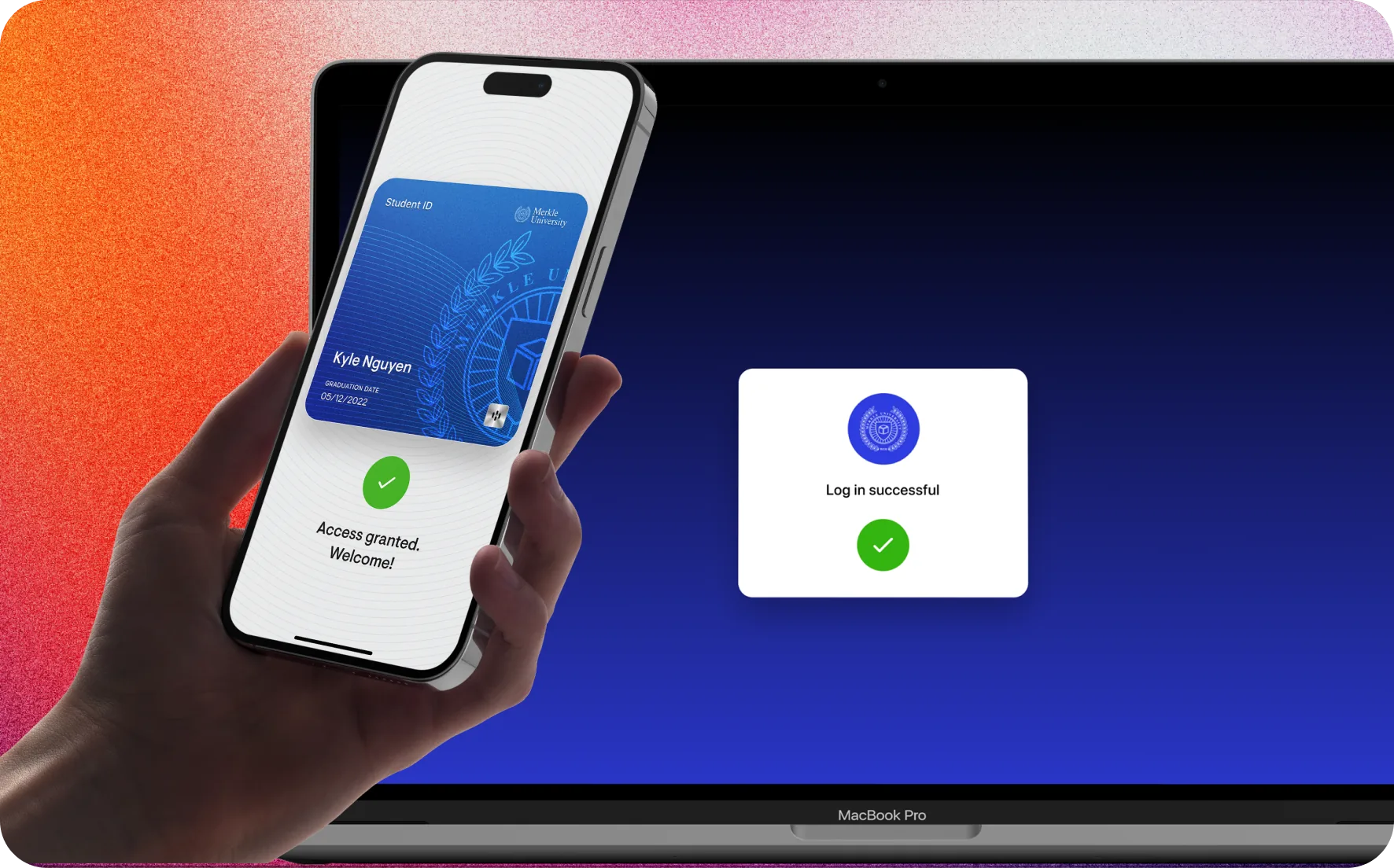
We inverted it. With QuickLogin, the website or the venue presented the QR code: an access request wrapped in a cryptographic challenge. You pointed your camera at it and got deep-linked into the Heirloom app, which showed you in plain language exactly what the counterparty wanted to know about you. Approve, and your phone’s biometrics signed a claim with your identifier’s key. Authenticated. No username, no password, no rummaging through your inbox for the ticket email. The system brought the challenge to you instead of making you reconstruct who you were trying to be.
The whole handshake averaged 2.7 seconds, and users loved it.
And unlike the passkeys the platform companies were shipping at the time, it wasn’t locked to one device ecosystem, and it could carry more than a login. The same rails that authenticated you could hold your transcript.
Selling trust in winter
Our timing was almost comically bad. We closed the seed weeks after crypto’s all-time peak. Luna collapsed the following May. FTX detonated that November, days after I’d said in an interview that the next quarters would be challenging. Prospects began saying the word “blockchain” back to us in a new tone. Where it was once spoken with opportunity and mystique, it was now said deadpan, so we expunged it from our own pitch.
What we sold was decentralized trust, and we sold it to triple-A institutions.
By early 2024, the math demanded a hard decision. I ran a large round of layoffs, as thoughtfully and transparently as we could manage inside the culture we’d built, and it was among the most emotionally difficult things I’ve done as a leader. It bought us at least six months of runway. We would have died earlier without it.
The doorstep
Our flagship pilot was with the University of Southern California: digital degrees and transcripts, issued as verifiable credentials signed from the university’s identifier to each graduate’s own. It shipped. Students, professors, and administrators celebrated it, and we issued thousands of real credentials. The pilot proved the thesis end to end, and it brought us to the table for a contract worth millions of dollars a year: long-term issuance of degrees and transcripts, plus an identity-and-access pilot for university login. The kind of contract that changes a company’s life.
In early July 2024, at the lawyers-and-contract-terms stage, on the doorstep of our Series A, the deal fell apart.
I gave notice to the team almost immediately, and extended everyone’s healthcare benefits for as long as I could.
There was one more chapter. An acquirer surfaced, introduced by a champion of our work, and through that fall we took the meetings, flew to New York, and fielded a verbal offer. The terms were ones our board couldn’t accept. The deal fell through, and we wound the company down.
What still exists
Here is the part I find hardest, and most clarifying. The identifiers we minted live on the Polygon blockchain, and they are still there: permanent, exactly as designed. But the infrastructure that hosted and decrypted the credentials went dark with our servers. The permanence survived; the meaning didn’t. A startup with limited resources has to brutally prioritize survival over architectural perfection. We did, and this is what that trade looks like when you lose anyway.
One piece outlived us in a way I didn’t expect. Julian contributed to XLS-40, the standard that brought decentralized identifiers to the XRP Ledger itself. It launched after we shut down. Our company died; some of its convictions shipped anyway.
Do I still believe the thesis? Yes. I said in 2022 that blockchains bring object permanence to bits, and I believe it now. The market financialized itself into a credibility crisis, and then generative AI pulled the oxygen out of the funding room. The idea is still waiting for its moment. We were early, and in startups, early and wrong cash the same check.
What it taught me
- Don’t scale ahead of revenue.
- The longer the sales cycle, the bigger the top of your funnel needs to be.
- Pilots are enthusiasm, not necessarily market signal.
- Alignment with strategic investors is less straightforward than with institutional investors, and it needs ongoing maintenance.
This is the second story on this site that ends with a shutdown. I thought about writing around that. I’d rather you know exactly how I run companies when things break: notice given the same week, healthcare extended, every hard call made in the open. Judgment like that is formed the expensive way, and it’s what you get with me.
At Heirloom I said one thing to the team so often they teased me about it: “You haven’t had your best idea yet.” It fell out of my mouth in some meeting and stuck. I believe it more now than when I first said it. Julian and I are building Familiar today, and there are days it feels like the best idea we’ve ever had. The sentence still applies. That’s the point of it.
Keep taking swings.